Advanced Optical Control
-
We developed and build advanced optical control systems that can be added to existing laser scanning or stage scanning microscopes
-
We also develop and build stand-alone optical control systems based on confocal fluorescence microscopy
-
Perturbation laser optional from UV to IR (350-1450 nm), from CW to fs pulsed lasers
-
Supervised and unsupervised (automated) options
-
Chemically selective
-
Submicron spatial precision
-
Sub-microsecond response time
-
Longitudinal live cell readout up to 72 hours

Real-time precision opto-control (RPOC)
RPOC stands for Real-Time Precision Opto-Control. It enables unprecedented flexibility, spatial precision, and chemical selectivity for regulating chemical processes within live biological samples.
RPOC can be integrated into any custom laser-scanning microscopes or stage-scanning microscope platforms.
How does RPOC work?

-
The imaging laser excites chemical signals
-
Chemical signals then activate action lasers.
-
Action lasers modulate and control the chemical processes.
-
The readout lasers record the resulting changes.
-
All of these steps are performed simultaneously in real time within the same pixel.
Terminology
-
Action laser: The lasers that are employed to precisely manage and regulate chemical activities within the sample.
-
Excitation laser: The lasers that are employed to excite chemically selective optical signals from the sample.
-
APX: active pixels. The specific pixels on which the action lasers are activated.
-
Comparator circuit: The circuit that is utilized to compare intensities of optical signals with user-defined criteria, such as an intensity threshold.
-
S-RPOC: software-assisted RPOC, provides the maximum flexibility and throughout
Key components of RPOC
1. Chemical detection (imaging)
RPOC is based on chemical imaging. Various optical modalities can be used for chemical detection in RPOC. Examples include:
-
Single-photon fluorescence (most widely used)
-
Two-photon fluorescence
-
Stimulated Raman scattering
-
Transient absorption
-
Harmonic generation
2. Opto-control
Optical means to provide precision control:
-
CW-laser: inducing reactive oxygen species (ROS); regulating photoswitchable inhibitors; photobleaching; adaptive FRAP and FLIP; small molecular uncaging
-
Femtosecond lasers: ROS generation; low-density plasma generation; multiphoton absorption; small molecular uncaging; localized wounding
-
Near or mid-infrared lasers: localized heating
3. Readout (imaging)
-
Short-term: Fluorescence signal changes, protein dynamics, intracellular organelle dynamics, cell morphology, ROS generation, etc.
-
Long-term: Cell migration, cell viability, cell division, and microenvironment-related changes such as hypoxia or nutrition deprivation.
Hardware
Key hardware to convert laser-scanning microscope to RPOC system including:
Comparator circuits
Enables real-time target tracking and decision-making, which is essential for precise control of highly dynamic chemical targets.

Acousto-optic modulators
Enables rapid activation of action lasers in response to detected chemical signals. First-order diffraction is used to ensure complete laser cutoff at TTL = 0.

Python based RPOC software (PyRPOC, a unified UI)

For Python users and developers:The software provides core laser-scanning and image-acquisition capabilities, along with advanced RPOC features for ROI selection and action-laser control. It also enables intra-pixel optical decoupling to suppress or exclude signal enhancement from the action laser.Fully compatible with comparator circuit integration.
Example Applications
Localized inhibition of microtubule polymerization
RPOC can inhibit chemical processes at selected locations. For example, pairing with a photoswitchable inhibitor PST-1, RPOC can inhibit microtubule polymerization only in ER, or only in selected cells within a population, without affecting unwanted locations.
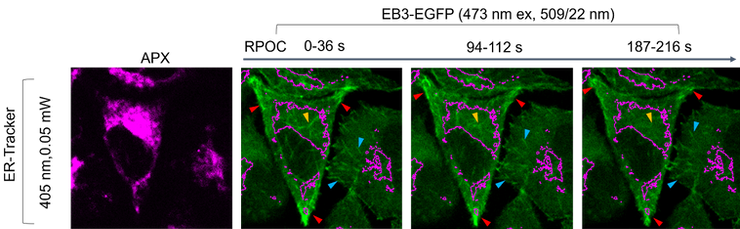


Dong, et al. Adv Sci, 2024, 2307342
Dong, et al. ACS Photonics, 12, 7, 3421-3434
Site-specific ROS generation
RPOC can generate ROS in selected organelles and quantify the laser dosage received by each cell. The dosage can be well correlated to cell responses. Lasers used for ROS generation include: 375 nm laser, 405 nm laser, and femtosecond NIR laser


Dong, et al. Adv Sci, 2024, 2307342
Ma, et al. Small Sci, 2025, 2500166
Single-organelle microsurgery
RPOC can perform single- or sub-organelle microsurgery without affecting unwanted locations.


Ma, et al. Small Sci, 2025, 2500166
Selective organelle perturbation and ROS generation
RPOC permits selective organelle perturbation using lasers and the generation of ROS solely in desired organelles. The interactive software allows to outline any cells. The signal-based APX selection permits automated target identification with optimal spatial precision. The generation of ROS in mitochondria induces leaking of MitoTracker into cytosol and oxidation of cellular EGFP.

Dong, et al. ACS Photonics, 12, 7, 3421-3434
Simultaneous treatment with different wavelengths
RPOC can simultaneously create different treatment conditions within the same field of view (FOV). This allows enhancement of the throughput and the study on how cells treated differently interact with each other. RPOC also enables fixed laser dosages for treatment of desired targets, or automatic stop of treatment after reaching a desired signal level. For example, it can photobleach fluorophores to any defined level and then automatically stop the photobleaching process.


Dong, et al. ACS Photonics, 12, 7, 3421-3434
Control of cell division
RPOC can control cell division and force cells to divide into the multi-nuclei form by perturbing centrosomes using a 405 nm laser. We can control the fate of cells after site-specific and chemical-specific optical control. The cell fate can be monitored in long-term to determine the impact of optical control.

Dong, et al. ACS Photonics, 12, 7, 3421-3434
Control chemical states in live cells
RPOC allows to site-specifically control states of photochromic molecules with submicron precision. As an example, a photoswitchable molecule cis−1,2-dicyano1,2-bis(2,4,5-trimethyl-3-thienyl)ethene (CMTE) is used.

Clark, et al. Nat Commun, 2022, 13, 4343
Raman activated cell-sorting
RPOC allows to perform Raman activated sorting of bacteria with high speed and specificity
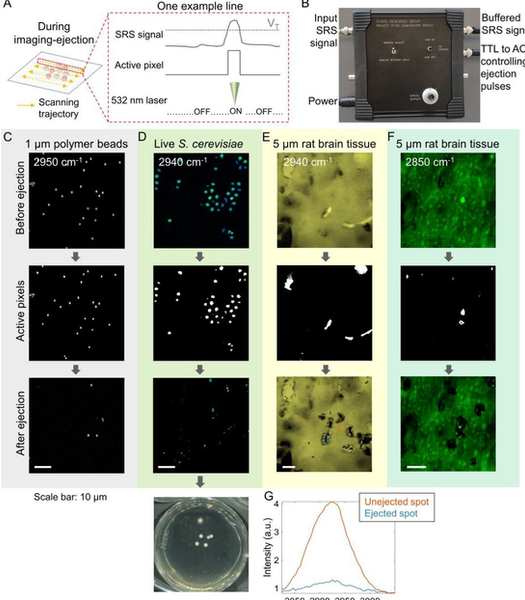
Zhang, et al. Sci Adv, 2024, 10, eadp2438